Your phone groups photos by faces, and a chatbot answers a question in seconds. These everyday examples show how AI works: it finds patterns in data and uses them to make predictions or create output.
The results can seem human-like, but fluent output doesn’t mean a system understands your situation or knows what’s true. Its abilities depend on its training, your instructions, and the information it can access.
Learning, response generation, and those limits all start with the same basic process.
How AI works, from examples to useful predictions
For many modern AI systems, people choose training data and a goal, such as recognizing an animal. A model learns patterns from those examples. After training, it applies those patterns to unfamiliar inputs to produce a prediction.
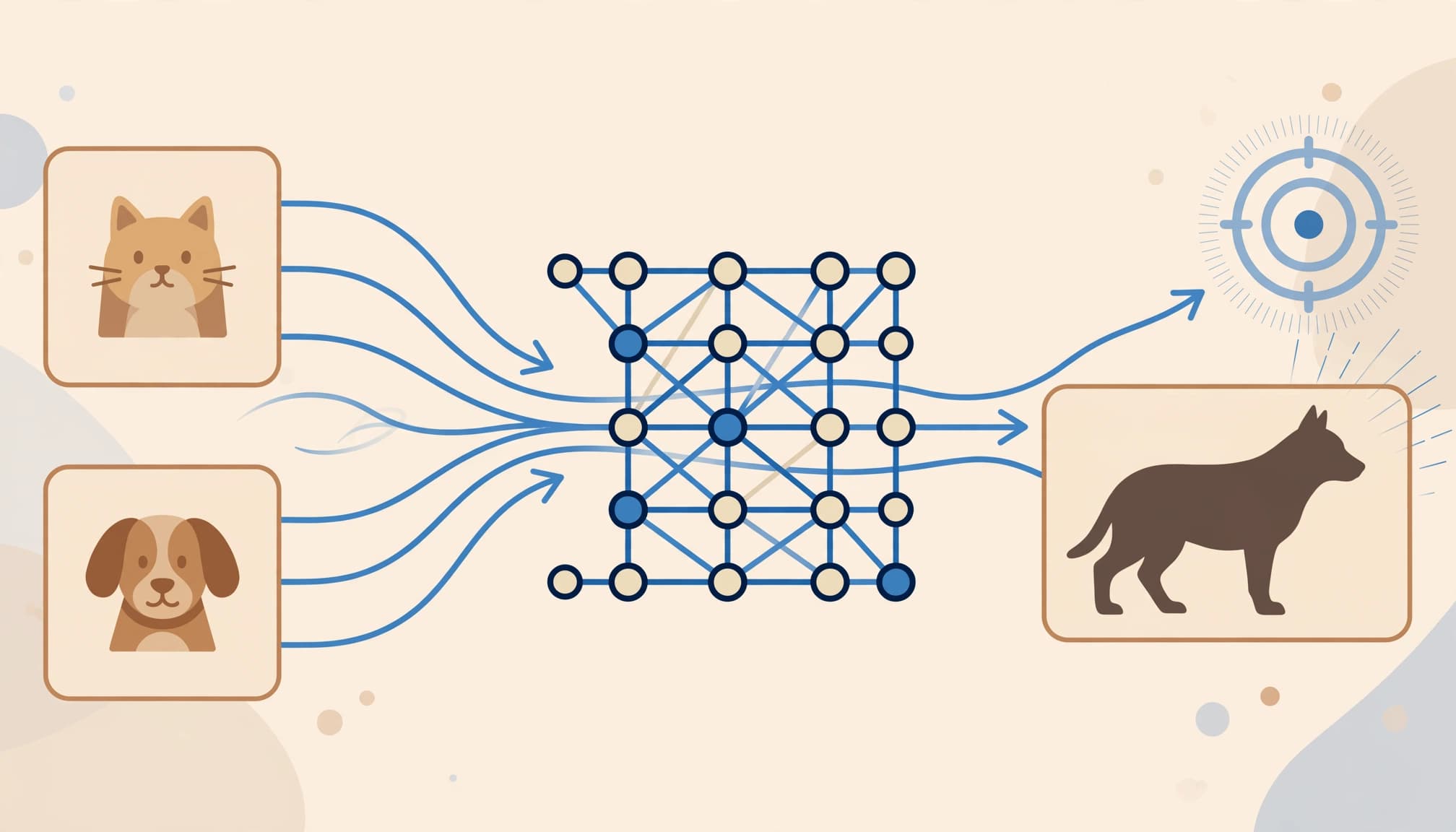
Training teaches a model to spot patterns
To train a model to distinguish cats from dogs, developers provide images with the correct labels. The model makes guesses, compares them with those labels, and adjusts internal settings called parameters to reduce errors.
This repeats across many examples. Separate test images help reveal whether the model can handle new pictures rather than memorize its training set. Training improves performance on a task; it doesn’t give the model a person’s experience of animals.
Machine learning and deep learning are ways AI learns
Machine learning lets systems learn patterns from examples instead of requiring a handwritten rule for every situation. MIT’s explanation of machine learning describes it as a subfield of AI.
Deep learning is one kind of machine learning. It uses neural networks: layers of connected calculations that transform inputs into useful patterns. These networks can handle images, speech, and text. Despite the name, they don’t learn exactly like human brains.
What kinds of AI do people use today?
AI covers several methods, so how AI works depends on the system. Three common categories differ in what they produce.
Rule-based systems follow instructions people write. A rule-driven support menu routes a billing question to the billing department. More sophisticated systems combine rules to reach conclusions. However, a basic menu may be ordinary automation rather than AI.
Predictive AI estimates an outcome or assigns a category. For example, a bank’s fraud detection model can flag a transaction that differs from normal spending patterns. That flag expresses a judgment about risk, not proof of fraud.
Generative AI creates content, such as a draft email, an image, or computer code, using patterns learned during training. ChatGPT is one familiar example.
Many tools combine methods. A customer-service assistant might generate replies while using fixed rules to decide when it must transfer you to a person.
How AI turns a prompt into a response
When you enter a prompt into a language-based generative tool, the trained model processes your input and generates output. Applying a trained model is called AI inference. Other AI systems may classify images or estimate risks instead of producing conversation.
A language model breaks text into pieces and predicts what comes next
A language model converts text into small units called tokens. A token may be a word, part of a word, or punctuation.
The model processes relationships among these tokens using patterns learned during training. It then predicts likely next tokens, adding them one after another to form a response.
Those predictions depend on the input and the text already generated. The process can produce fluent explanations, but it doesn’t automatically establish whether a statement is true. A plausible sequence of words can contain an invented fact.
The prompt and surrounding context shape the result
Clear instructions narrow the task. Asking for a short explanation for a fifth grader provides more direction than asking for an explanation.
Useful context also matters. A model summarizing a document needs the document’s contents, not merely its title.
Learned information differs from fresh information supplied during a conversation. If connected to search or other tools, an assistant may retrieve current material. Without that access, it shouldn’t claim to know what happened today.
What AI can do well, and where human judgment matters
AI can sort large collections of information, detect recurring patterns, and produce first drafts quickly. For example, email filters classify incoming messages, while speech-recognition systems convert audio into text.
These strengths work best when the task has a clear goal and someone can evaluate the result. A draft can save time because you can revise it. Meanwhile, an unchecked answer can spread mistakes.
Because machine learning relies on training data, gaps or skewed examples can affect predictions. A model may perform poorly on inputs unlike those it encountered during training. Generative tools can also produce incorrect details or rely on outdated information.
Human review matters most when an error could harm someone or affect a major decision. Keep these habits practical:
- Compare important claims with reliable sources, especially for health, legal, or financial decisions.
- Don’t paste passwords, medical records, or confidential work documents into an unapproved tool.
- Review drafts for errors and unfair assumptions before using or sharing them.
A confident tone shouldn’t increase your trust by itself. Treat an AI response as material to assess, and keep responsibility for the final decision.
Use AI with Curiosity and Judgment
Knowing how AI works helps you judge its output more clearly. Many systems learn patterns from data and apply them to new tasks, but that process doesn’t guarantee truth or understanding of your intent.
Use AI to support your work while keeping verification part of the process.
Stay curious about what it can do, and check important results before relying on them.